Mobile App
Townder
Creating custom city routes and exploring architecture through walking tours
Industry Travel
Role UI/UX Designer
Tools Figma, FigJam
Skills
UX Design
Stakeholder Interview
User Interview
Customer Journey Map
Wireframing
Prototyping
User Testing
UI Design
mockuuups-man-pointing-on-ipad-mockup 1
About the client Townder is an innovative startup focused on developing a mobile app designed for creating personalized travel routes and uncovering hidden gems within a city. The app also aims to contribute to the preservation of historical landmarks and cultural heritage, ensuring these treasures remain integral parts of the urban experience.
Problem The challenge lies in preserving irreplaceable historical and cultural landmarks while ensuring their history remains alive, accessible, and engaging for a modern audience.
Task Create a scenario for generating and following a personalised route by the user.
Reasons why people desire a сustomized road:

Clipped-9
"I'm bored of the same routes— I want something new."

Clipped-5
"It'd be cool to learn the history of landmarks as I go."

Clipped
"I wish I could find more off-the-beaten-path routes."
Workflow
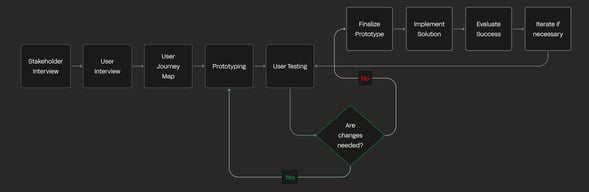
Frame 2609045 2
Before the interview, we composed questions according to:
Questions according to:
◽️ competitors
◽️ the tasks the product should perform
◽️ the audience
◽️ user experience
◽️ possible metrics
Key insights
💡 Preserve historical and cultural heritage
💡 Offer personalized, engaging walking routes
💡 Highlight lesser-known landmarks and attractions
💡 Test hypotheses based on existing user flows
Questions example
image 99
02 User interview We started by writing down all the questions that came to mind. Then, we looked for patterns and grouped similar questions together. Finally, we arranged them in a logical order, beginning with simple, general questions and moving on to more specific and complex ones.
Warmup
Tell us about yourself, how old are you, how do you usually spend your free time?
How often do you go for a walk? How long does it usually take?
Tell us about yourself, how old are you, how do you usually spend your free time?
Main Questions
Tell us about your recent walk. How did you plan it? What was important to you when planning the route?
What criteria are important to you when creating your own route (distance, duration of the walk, etc.)?
Do you use any apps or resources to build your walking routes?
If yes, which ones?
What did you like or dislike about using it?
+ 9 more
Key insights
  • Users are looking for personalised and unique walking experiences that cater to their specific interests.
  • There is a high demand for non-touristic, off-the-beaten-path routes that provide a fresh perspective of the city.
  • Users appreciate having detailed historical and cultural information about landmarks along their route.
  • Convenience and ease of navigation are crucial for users when following customized routes.
  • Pet-friendly routes and establishments are a significant consideration for many users.
03 Post-User Interview Synthesis
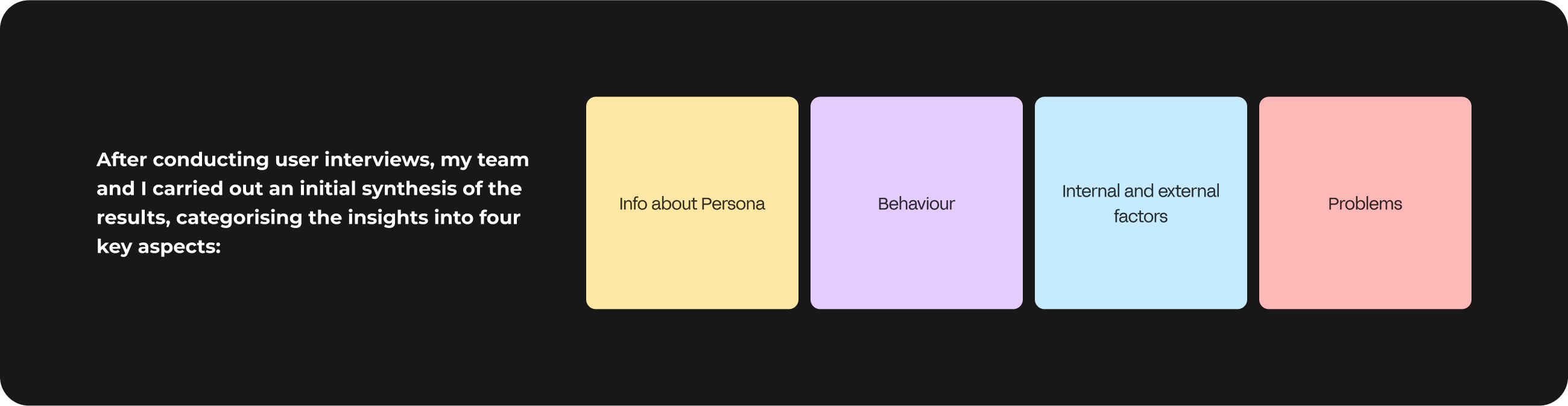
After conducting user interviews, my team and I carried out an initial synthesis of the results, categorising the insights into four key aspects:
image 100
image 101
04 Customer Journey Map
We analysed the data from the interview to compile the CJM. This helped us to clearly identify user pain points and develop possible solutions.
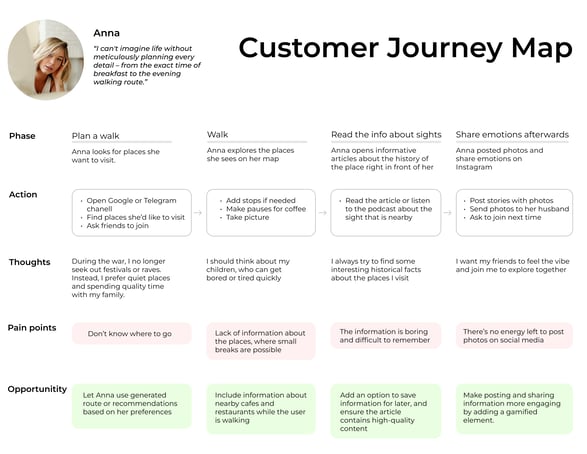
journey-map-4 1
How did we prioritise our opportunities?
We used Desirability/Feasibility/Viability or ICE (Impact/Confidence/Ease) Framework. This Framework is the most common and easiest to apply. Our team established a custom scale for evaluating each opportunity and then selected the one with the highest rating.
image 92
05 User Testing : what didn’t work
We tested newly done screens + screens from existing flow. Below are the problems that users encountered during testing + solutions that we believe will help solve them.
We introduced thematic recommended routes to help users explore unique locations and uncover hidden gems within the city. These curated routes cater to specific interests, offering a more engaging and personalized way to discover the charm of less-traveled places.
06 Final Design
To simplify the user flow and declutter the homepage, we introduced a brief onboarding process that helps users easily set their preferences.
Screen [CHANGE ME]
Before
After
We also added a feature that suggests recommended routes, helping users discover hidden gems and unique spots for a richer experience. After reviewing these options, users can start their journey directly with one tap.
Screen [CHANGE ME]
Screen [CHANGE ME]
We enhanced route customization by allowing users to remove unwanted spots from their route.
Screen [CHANGE ME]
Thanks for watching.
istockphoto-1265553634-170667a-Photoroom 1
Industry Travel
Role UI/UX Designer
Tools Figma, FigJam
Skills
UX Design
Stakeholder Interview
User Interview
Customer Journey Map
Wireframing
Prototyping
User Testing
UI Design
mockuuups-man-pointing-on-ipad-mockup 1
About the client Townder is an innovative startup focused on developing a mobile app designed for creating personalized travel routes and uncovering hidden gems within a city. The app also aims to contribute to the preservation of historical landmarks and cultural heritage, ensuring these treasures remain integral parts of the urban experience.
Problem The challenge lies in preserving irreplaceable historical and cultural landmarks while ensuring their history remains alive, accessible, and engaging for a modern audience.
Task Create a scenario for generating and following a personalised route by the user.
Reasons why people desire a сustomized road:
Clipped-9
"I'm bored of the same routes— I want something new."
Clipped-5
"It'd be cool to learn the history of landmarks as I go."
Clipped
"I wish I could find more off-the-beaten-path routes."
Workflow
Frame 2609045 1
DISCOVER
Stakeholder interview
Before the interview, we composed questions according to:
Questions according to:
◽️ competitors
◽️ the tasks the product should perform
◽️ the audience
◽️ user experience
◽️ possible metrics
Key insights
💡 Preserve historical and cultural heritage
💡 Offer personalized, engaging walking routes
💡 Highlight lesser-known landmarks and attractions
💡 Test hypotheses based on existing user flows
Questions example
The task and about the project
What are the biggest challenges your company is facing right now that could be addressed with the help of this app?
What artifacts (files) do you want to receive as a result of our work?
Do we have any technical limitations that should be considered?
What functionality should be added or can be improved?
How can we understand, that the app is working effectively?

(metrics)
Audience
What is the ultimate goal of the users?
What are the biggest challenges users face when planning or building their route?
Why would users potentially choose your product?
Have you encountered cases where users planned to build a route using the app but then decided against it?
+3 more sections
Process
image 97
User 1
image 95
me, conducting interview
image 94
User 2
DISCOVER
User interview
3d-female-character-with-question-marks
We found ourselves stuck in a cycle of disagreement over which questions were truly important for the user interview.
13678508_5178406-Photoroom
As a team, we decided to prioritize based on user impact. We rated the questions by importance and urgency, each picked our top three, and then compared to find the most crucial ones.
Key insights
💡 Users want personalized walking routes tailored to their interests
💡 High demand exists for non-touristic, hidden-gem paths offering a unique city perspective
💡 Historical and cultural details about landmarks enhance the user experience.
💡 Many users prioritize pet-friendly routes and stops
DEFINE
Post-User Interview Synthesis
After conducting user interviews, my team and I carried out an initial synthesis of the results, categorising the insights into four key aspects:
Info about Persona
Behaviour
Internal and external factors
Problems
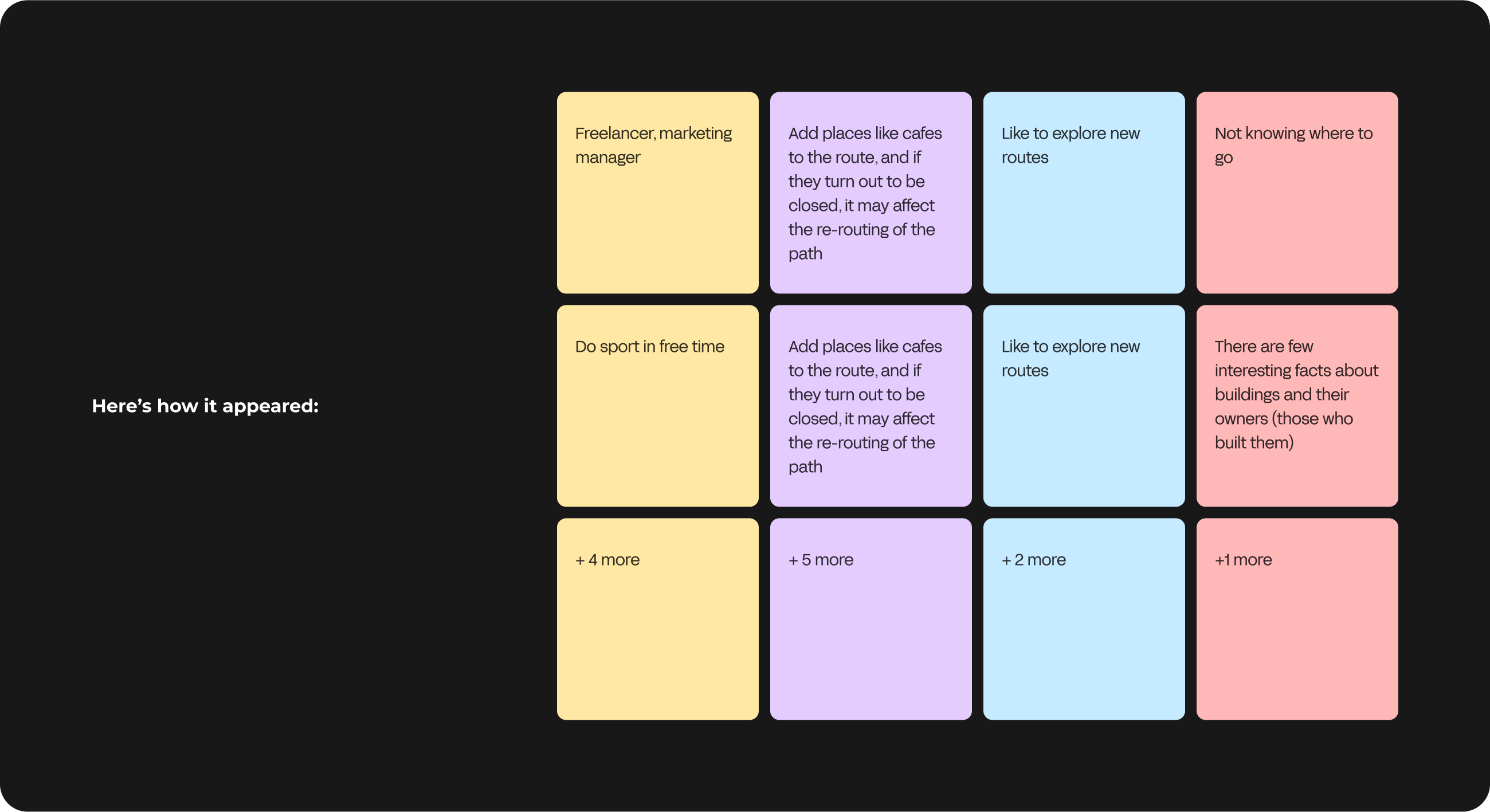
Here’s how it appeared:
Freelancer, marketing manager
Do sport in free time
+ 4 more
Add places like cafes to the route, and if they turn out to be closed, it may affect the re-routing of the path
+ 5 more
Like to explore new routes
+ 2 more
Not knowing where to go
There are few interesting facts about buildings and their owners (those who built them)
+1 more
DEFINE
Customer Journey Map
We analysed the data from the interview to compile the CJM. This helped us to clearly identify user pain points and develop possible solutions.
journey-map-4 1
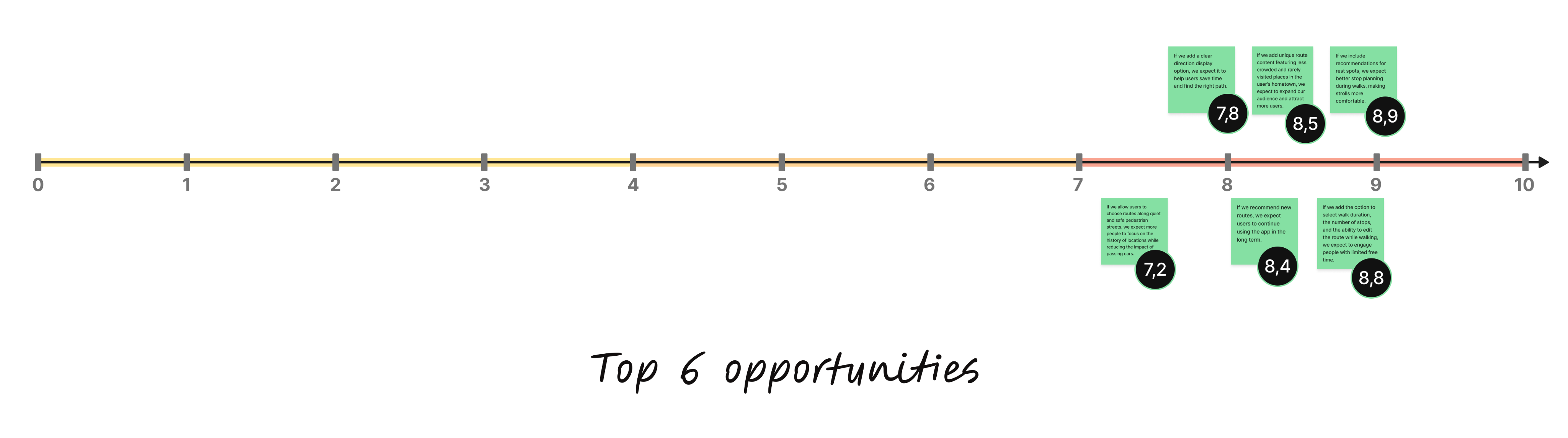
How did we prioritise our opportunities?
We used Desirability/Feasibility/Viability or ICE (Impact/Confidence/Ease) Framework. This Framework is the most common and easiest to apply. Our team established a custom scale for evaluating each opportunity and then selected the one with the highest rating.
image 92
DEVELOP
User Testing : what didn’t work
We tested newly done screens + screens from existing flow. Below are the problems that users encountered during testing + solutions that we believe will help solve them.
Home Page
Problem: Users struggled to understand the purpose of tags (e.g., preferred types of places like parks or squares) and how they impacted the route generation process. Solution: We addressed this issue by incorporating the step of choosing tags into the onboarding process.
Route Customisation
Problem: Users are unable to figure out how to delete a spot from the route once it has been generated. Solution: We enhanced route customisation by allowing users to remove unwanted spots from their route effortlessly by swiping in the route list.
We introduced thematic recommended routes to help users explore unique locations and uncover hidden gems within the city. These curated routes cater to specific interests, offering a more engaging and personalized way to discover the charm of less-traveled places.
06 Final Design
To simplify the user flow and declutter the homepage, we introduced a brief onboarding process that helps users easily set their preferences.
Before
Screen [CHANGE ME]
After
We also added a feature that suggests recommended routes, helping users discover hidden gems and unique spots for a richer experience. After reviewing these options, users can start their journey directly with one tap.
Screen [CHANGE ME]
Screen [CHANGE ME]
We enhanced route customization by allowing users to remove unwanted spots from
their route.
Screen [CHANGE ME]
Thanks for watching.
istockphoto-1265553634-170667a-Photoroom 1
Industry Travel
Role UI/UX Designer
Tools Figma, FigJam
Skills
UX Design
Stakeholder Interview
User Interview
Customer Journey Map
Wireframing
Prototyping
User Testing
UI Design
mockuuups-man-pointing-on-ipad-mockup 1
About the client Townder is an innovative startup focused on developing a mobile app designed for creating personalized travel routes and uncovering hidden gems within a city. The app also aims to contribute to the preservation of historical landmarks and cultural heritage, ensuring these treasures remain integral parts of the urban experience.
Problem The challenge lies in preserving irreplaceable historical and cultural landmarks while ensuring their history remains alive, accessible, and engaging for a modern audience.
Task Create a scenario for generating and following a personalised route by the user.
Reasons why people desire a сustomized road:
Clipped-9
"I'm bored of the same routes— I want something new."
Clipped-5
"It'd be cool to learn the history of landmarks as I go."
Clipped
"I wish I could find more off-the-beaten-path routes."
Workflow
Frame 2609045 1
DISCOVER
Stakeholder interview
Before the interview, we composed questions according to:
Questions according to:
◽️ competitors
◽️ the tasks the product should perform
◽️ the audience
◽️ user experience
◽️ possible metrics
Key insights
💡 Preserve historical and cultural heritage
💡 Offer personalized, engaging walking routes
💡 Highlight lesser-known landmarks and attractions
💡 Test hypotheses based on existing user flows
Questions example
The task and about the project
What are the biggest challenges your company is facing right now that could be addressed with the help of this app?
What artifacts (files) do you want to receive as a result of our work?
Do we have any technical limitations that should be considered?
What functionality should be added or can be improved?
How can we understand, that the app is working effectively?

(metrics)
Audience
What is the ultimate goal of the users?
What are the biggest challenges users face when planning or building their route?
Why would users potentially choose your product?
Have you encountered cases where users planned to build a route using the app but then decided against it?
Hypothesis
Is there a need for users to have social features, such as inviting friends, sharing routes, etc., and the possibility of group routes?
Have you considered gamifying the process by incorporating statistics and achievements to enhance user engagement?
The importance for users to keep 'Walk' mode active when accessing additional information, such as details about a building.
+2 more sections
Process
image 97
User 1
image 95
me, conducting interview
image 94
User 2
DISCOVER
User interview
3d-female-character-with-question-marks
We found ourselves stuck in a cycle of disagreement over which questions were truly important for the user interview.
13678508_5178406-Photoroom
As a team, we decided to prioritize based on user impact. We rated the questions by importance and urgency, each picked our top three, and then compared to find the most crucial ones.
Key insights
💡 Users want personalized walking routes tailored to their interests
💡 High demand exists for non-touristic, hidden-gem paths offering a unique city perspective
💡 Historical and cultural details about landmarks enhance the user experience.
💡 Many users prioritize pet-friendly routes and stops
DEFINE
Post-User Interview Synthesis
After conducting user interviews, my team and I carried out an initial synthesis of the results, categorising the insights into four key aspects:
Info about Persona
Behaviour
Internal and external factors
Problems
Here’s how it appeared:
Freelancer, marketing manager
Do sport in free time
+ 4 more
Add places like cafes to the route, and if they turn out to be closed, it may affect the re-routing of the path
+ 5 more
Like to explore new routes
+ 2 more
Not knowing where to go
There are few interesting facts about buildings and their owners (those who built them)
+1 more
DEFINE
Customer Journey Map
We analysed the data from the interview to compile the CJM. This helped us to clearly identify user pain points and develop possible solutions.
journey-map-4 1
How did we prioritise our opportunities?
We used Desirability/Feasibility/Viability or ICE (Impact/Confidence/Ease) Framework. This Framework is the most common and easiest to apply. Our team established a custom scale for evaluating each opportunity and then selected the one with the highest rating.
image 92
DEVELOP
User Testing : what didn’t work
We tested newly done screens + screens from existing flow. Below are the problems that users encountered during testing + solutions that we believe will help solve them.
Home Page
Problem: Users struggled to understand the purpose of tags (e.g., preferred types of places like parks or squares) and how they impacted the route generation process. Solution: We addressed this issue by incorporating the step of choosing tags into the onboarding process.
Route Customisation
Problem: Users are unable to figure out how to delete a spot from the route once it has been generated. Solution: We enhanced route customisation by allowing users to remove unwanted spots from their route effortlessly by swiping in the route list.
We introduced thematic recommended routes to help users explore unique locations and uncover hidden gems within the city. These curated routes cater to specific interests, offering a more engaging and personalized way to discover the charm of less-traveled places.
06 Final Design
To simplify the user flow and declutter the homepage, we introduced a brief onboarding process that helps users easily set their preferences.
Before
Screen [CHANGE ME]
After
We also added a feature that suggests recommended routes, helping users discover hidden gems and unique spots for a richer experience. After reviewing these options, users can start their journey directly with one tap.
Screen [CHANGE ME]
Screen [CHANGE ME]
We enhanced route customization by allowing users to remove unwanted spots from
their route.
Screen [CHANGE ME]
Thanks for watching.
istockphoto-1265553634-170667a-Photoroom 1